A company’s IT strategy defines overarching guidelines to align IT with corporate strategy. It reflects the company’s appetite for risk versus stability, and many other preferences that shape decisions about make-or-buy, vendor selection, cost-effectiveness, sourcing models, architecture and governance.
In this article, we will look at one example where strategy meets IT reality, which many of our readers will be familiar with: large enterprise software projects. They show some of the characteristics of this level, and also the opportunities and risks of AI.
Large enterprise software projects go to the core of the company. This is why they are often called transformation projects.
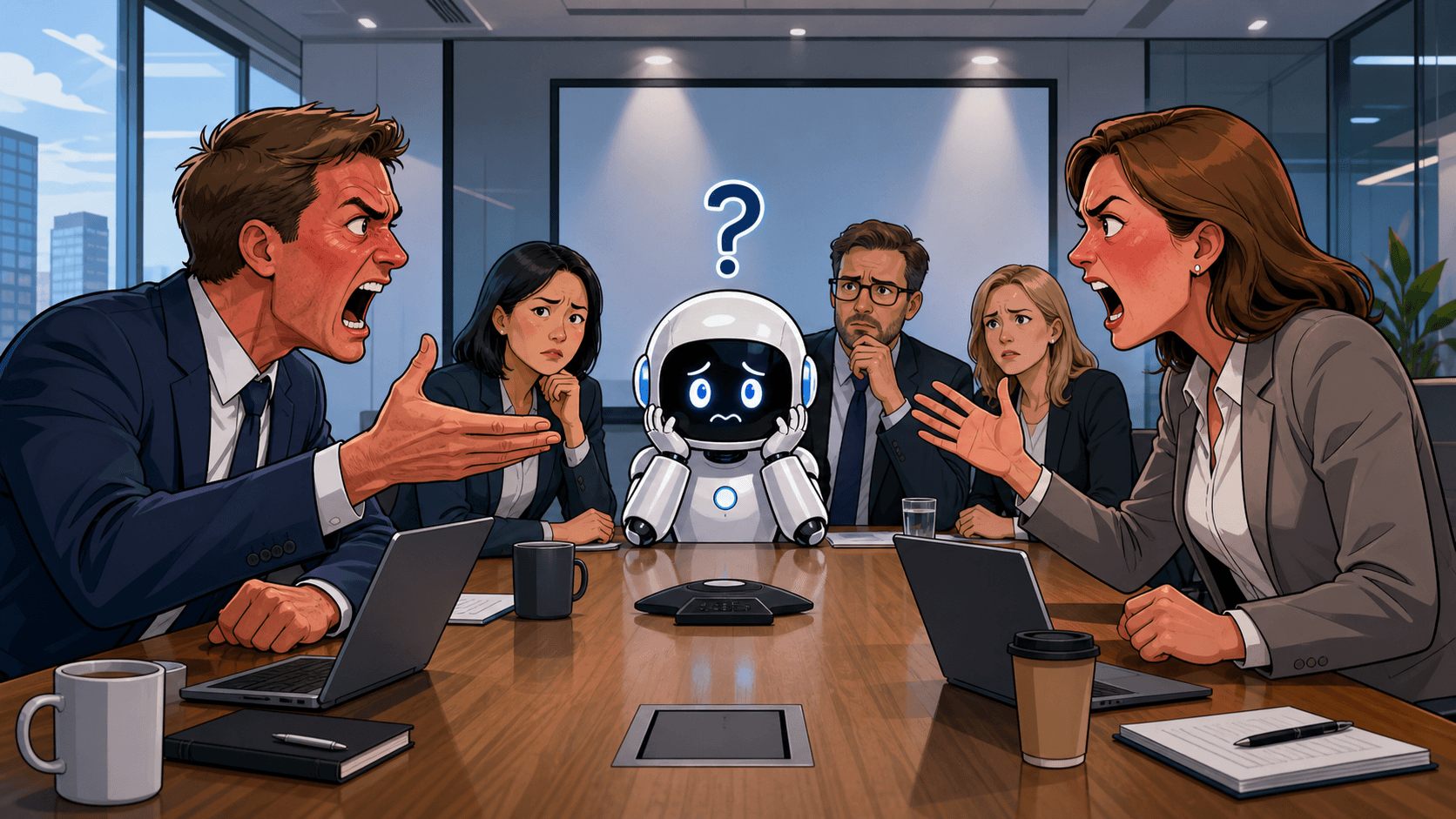
The negotiation in the transformation
At the beginning of such a project, some stakeholder will often formulate the initial mission of the project. “Replace the legacy software with SAP software. Do everything in SAP standard.” might be the short version of it. “Replace the legacy software and keep all features we need” might be another one. In the future, we may also hear: “Use AI to migrate all existing functionality to the new system.”
As the project progresses, it will become clear in most large projects that the official mission is not the full story.
Different stakeholders will have different views of what needs to be achieved to make the project a success for them. Finance and IT may argue for standardization, cost discipline and maintainability. Business departments often value feature richness, automation and flexibility, because they face customers, vendors and operational complexity.
In retail, this will often be sales, logistics and purchasing. These departments have to deal with the world outside the company’s walls, with the market power of vendors and customers, and with the need to automate complex real-life situations without overloading their teams with manual work.
This is the easy case.
In more complicated projects, we may see fractured ownership structures, different owners with different goals, regional organizations with their own priorities, or other stakeholders influencing the project without formally owning it.
Project management means solving conflicts
The friction arising from these different views will often surface later, at the tactical or delivery level: in workshops, specifications, test cases, budget discussions and escalation meetings. But the root of the conflict is often strategic.
For a project to be successful, these fundamental conflicts have to be resolved on the strategic level until the real mission is understood. If they remain unresolved, they will resurface again and again, and may eventually make the project fail.
Good project management does not ignore this friction. It makes it visible. It carries the conflict to the level where it can actually be resolved. It gives stakeholders the chance to acknowledge their differences without losing face. It helps the organization move from win-lose arguments to workable compromise.
The challenges in this are manifold: distilling the key conflicts from the endless amount of information on the tactical level, reading the room in stakeholder discussions, understanding what is said and, critically, what is not being said. Finding out about real priorities in one-on-one discussions. Coming up with solutions that will be acceptable at this level, at the right moment, to achieve lasting agreements.
How AI changes the game
So how will AI help us on this level?
It can surely help with summarizing diverging aims, structuring arguments, preparing meeting materials and condensing ideas into slide decks. This is useful, and it will save time.
But a major challenge is that much of the relevant context at this level does not exist in written form. It lives in conversations, trust, hesitation, past conflicts, personal convictions and things people deliberately avoid saying in meetings.
Recording all stakeholder conversations will not solve this, because it would change the nature of the conversation itself, weakening the signals we are trying to understand. A project manager or consultant could write down the context as they see it, but in many cases this may simply lead to AI confirming that person’s own view.
On the other hand, AI may also be detrimental to this process.
Stakeholders will feed their own point of view into AI systems. Given their selective choice of context, they will often receive confirmation from the AI. Finance will get confirmation that standardization is right. Sales will get confirmation that the requested feature is sensible.
If stakeholders meet, and each stakeholder has had their own opinion confirmed by a seemingly neutral AI assistant before the meeting, finding agreement may become more difficult, not easier.
Moreover, stakeholders’ confidence in their own judgment may decrease with the growing use of AI. Instead of using a moment in the discussion to find agreement, they may prefer to take the newly gained information back to their AI assistant to have it “fact-checked,” dragging out negotiation processes and decreasing the chance to seize the right moment.
Conclusion
We believe these traits are representative of the strategic level in many companies. The priorities, values and opinions shaping corporate and IT strategy are often not explicitly defined, but ingrained in personal convictions and beliefs. They can be made more explicit, for example by working with strategy consultants, and AI may help gather and synthesize these opinions.
But AI can only work with context that is made available to it.
In the end, the negotiation of priorities, values and goals will remain a deeply human affair.
AI tool fit: At this level, the specific model is less decisive than context quality, confidentiality and governance. Any enterprise-grade LLM with sufficient context length and GDPR-compliant deployment can help, if meaningful context can be shared safely.
What acceletail offers: We support customers in independently assessing planned or running transformation projects, clarifying meaningful AI use cases at the strategy and governance level, and combining AI-generated structure with actual organizational agreement.
What acceletail offers
If you want to discuss AI in SAP Retail, maintenance, projects or business processes, we are happy to start with a first conversation.
Get in touch